
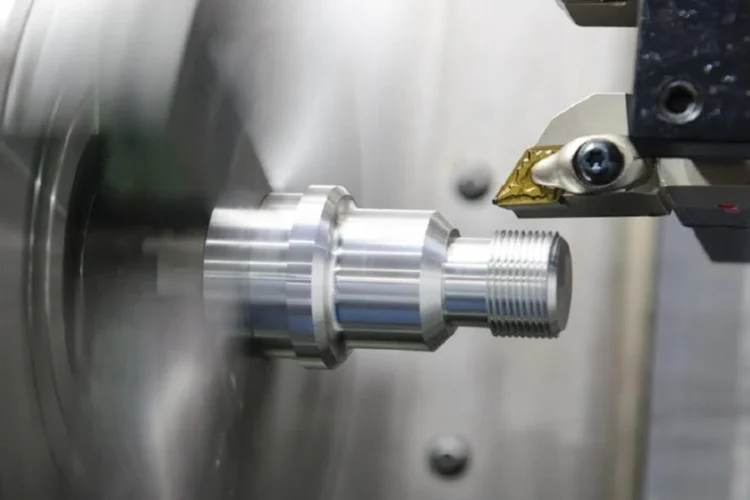
CNC turning is a highly sophisticated subtractive manufacturing process that utilizes computer-controlled machinery to transform raw materials into precise, high-performance cylindrical parts. By combining high-speed rotation with digital precision, CNC turning has revolutionized modern industry-delivering unmatched accuracy, efficiency, and repeatability. This article explores the fundamentals, equipment, operational methods, and real-world industrial applications of CNC turning, along with how precision partners like CS Rapid MFG bring these processes to life.
Fundamentals of CNC Turning
At its core, CNC turning involves securing a raw material workpiece-typically metal, engineering plastic, or composite bar stock-into the chuck of a CNC lathe or turning center. As the machine rotates the material at high speeds, single-point cutting tools are precisely driven along multiple axes (primarily the X and Z axes) to shave off excess stock and shape the component.
Modern CNC turning relies on integrated CAD (Computer-Aided Design) and CAM (Computer-Aided Manufacturing) workflows:
Digital Modeling: Engineers design a detailed 3D model within CAD software.
Code Generation: CAM software translates the geometry into G-code-the standardized language that dictates tool movement, spindle RPM, feed rates, coolant flow, and cutting depth.
Execution: The machine tool executes the G-code to generate complex features such as stepped outer diameters, precise tapers, internal bores, threads, and retention grooves with micro-level accuracy.
Key Advantages of CNC Turning
1. Exceptional Precision and Micro-Tolerances
Computer control eliminates manual operator variability, ensuring components consistently achieve tight dimensional tolerances within a few micrometers (or thousandths of an inch). This precision is critical in high-stakes sectors like aerospace and medical manufacturing.
2. High Production Efficiency and Reduced Overhead
CNC turning centers can operate continuously with minimal human intervention. Automated tool changers and bar feeders allow rapid production cycles, significantly lowering unit labor costs and cycle times compared to manual machining.
3. Engineering Flexibility and Fast Prototyping
Adapting to design updates or low-volume customization requires only updating the CAD/CAM files without costly physical re-tooling. This agility allows engineers to transition smoothly from rapid prototyping into full-scale production.
4. Workplace Safety and Ergonomics
With enclosed machining cabinets and automated chip conveyors, operators primarily focus on programming, setup verification, and quality monitoring-minimizing direct contact with high-speed rotary components and cutting zones.
CNC Turning Equipment and Tooling Systems
CNC Lathe Structure
Essential structural components include the bed (a heavy casting designed to absorb machining vibration), the headstock (housing the high-torque main spindle), the carriage (driving axes motion), and the tailstock (supporting long or slender workpieces).
Cutting Tool Materials
Depending on the material hardness, tooling options include High-Speed Steel (HSS), solid carbide, cermet, and ceramic inserts. Carbide tools are widely preferred for their exceptional hardness, high-temperature resistance, and tool life under high cutting speeds.
Tool Holders and Turrets
Indexable turrets hold multiple tools simultaneously (e.g., facing tools, boring bars, grooving inserts, and threading tools), allowing swift automatic tool changes within a single setup.
Standard CNC Turning Operations
CNC turning encompasses several fundamental machining operations:
External (OD) Turning: The tool moves parallel to the workpiece’s axis of rotation along the outer diameter, cutting cylindrical shafts, steps, and tapers.
Internal Turning (Boring): Enlarges, straightens, or finishes existing drilled holes to achieve precise internal diameters, tight concentricity, and fine surface finishes.
Facing: Moves the tool perpendicular to the rotational axis across the end of the stock, creating a flat reference surface.
Threading: Synchronizes spindle rotation with linear feed to cut precise internal or external screw threads (including metric, UNC/UNF, and ACME standards).
Grooving & Parting: Cuts narrow radial recesses for O-rings, snap rings, or completely severs the finished component from the raw bar stock.
Industry Applications & Manufacturing Services by CS Rapid MFG
Owing to its precision and material adaptability, CNC turning is a foundational process across key technology sectors:
- Aerospace & Defense: Manufacturing critical components such as engine shafts, landing gear pins, hydraulic valve bodies, and fuel nozzles.
- Automotive: High-volume production of engine pistons, crankshafts, camshafts, steering knuckles, and sensor housings.
- Medical Devices: Precision surgical instruments, orthopedic bone screws, and titanium dental implants requiring strict surface finishes and biocompatibility.
- Electronics: High-density connectors, heat sink cores, optical housings, and RF shielding enclosures.
Custom CNC Turning & Manufacturing Solutions by CS Rapid MFG
To execute complex turning projects with rapid lead times, partnering with a proven precision manufacturer is key. CS Rapid MFG (CS Mold Co., Limited) is an ISO 9001:2015 certified contract manufacturer specializing in custom CNC machining (both CNC turning and 3-/4-/5-axis CNC milling), rapid prototyping, sheet metal fabrication, and injection molding.
Operating out of an expansive facility with over 80 high-precision CNC machines, CS Rapid MFG provides end-to-end CNC turning services:
- Advanced Machining Infrastructure: Equipped with high-precision CNC lathes, live-tooling turning centers, and multi-axis machines capable of turning complex components from metals (stainless steel, titanium, aluminum, brass) and engineering plastics (PEEK, Delrin, Nylon).
- Rapid Turnaround & DFM Support: Every project undergoes thorough Design for Manufacturability (DFM) review prior to machining. Rapid prototypes can be delivered in as fast as 3 to 5 days with guaranteed dimensional compliance.
- Flexible Order Quantities: From single-unit prototype validation (No MOQ required) to volume production runs, CS Rapid MFG offers cost-effective global manufacturing solutions.
- For more information, technical resources, or to upload 3D CAD files for an instant 12-hour quote, visit .
Conclusion
CNC turning remains a core pillar of modern subtractive manufacturing. Its speed, repeatable accuracy, and geometric capabilities make it essential for transforming raw stock into mission-critical hardware. By leveraging the advanced turning infrastructure and technical expertise of global suppliers like CS Rapid MFG, companies can streamline their supply chain, reduce time-to-market, and achieve strict quality standards.