
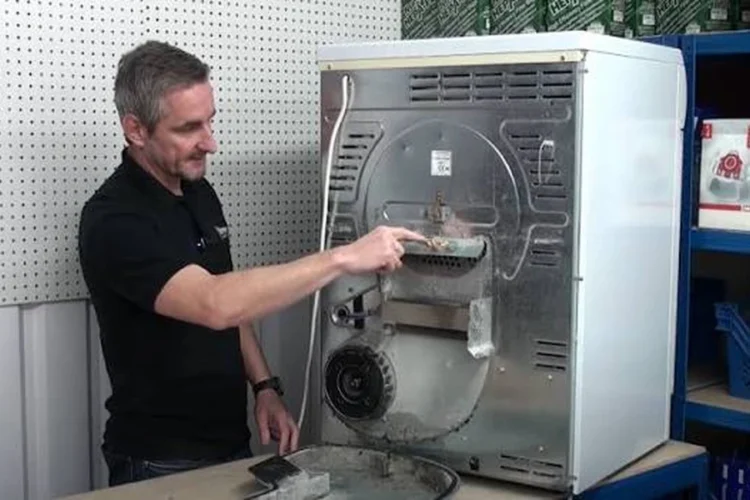
A dryer that tumbles normally but leaves clothes damp is one of the most common appliance complaints, and it is almost always misdiagnosed. People assume the heating element has failed. Far more often, the element is working perfectly and the heat cannot get out.
This guide covers the airflow-first diagnostic approach and the checks that resolve most cases.
Condenser cleaning intervals and supply requirements vary by model, and the Zanussi dryer manuals are the reference for anything beyond routine airflow checks.
Why airflow comes first
A dryer works by moving heated air through the load, picking up moisture and carrying it away. If that air cannot move freely, three things follow: clothes stay damp, cycle times extend, and the appliance’s thermal protection may cut the heat entirely to prevent overheating.
That last point is why an airflow restriction presents as a heating fault. The element is fine; the safety system is doing its job. It is also a genuine fire risk, which is why this is worth taking seriously rather than working around.
The checks, in order
1. The lint filter
Clean it before every load. Beyond removing visible lint, wash the filter periodically under running water – fabric softener and dryer sheets leave an invisible film that blocks airflow while the filter looks clean. Water should pass straight through a clean filter; if it pools, the filter needs washing.
2. The filter housing
Lint accumulates in the cavity below the filter. Vacuum it out with a narrow attachment. This is missed by almost everyone and is a common restriction point.
3. The vent hose
Check for kinks and crushing where the appliance sits against the wall. A hose squashed flat behind the machine is a frequent cause.
Disconnect and inspect the inside. Flexible hoses accumulate lint in their ridges.
Check the run length. Long runs with multiple bends restrict flow significantly.
Rigid ducting performs better than flexible foil where it can be used.
4. The external vent
Go outside and check the outlet while the dryer runs. You should feel strong warm airflow. Weak or no airflow with the hose clear means a blockage at the outlet – commonly a flap seized shut, a bird’s nest, or accumulated lint at the wall.
Condenser and heat pump models
These do not vent externally and have their own maintenance requirements:
Empty the water container after every cycle, or check the drain hose if plumbed in. A full container stops the cycle.
Clean the condenser unit at the documented interval. A clogged condenser is the direct equivalent of a blocked vent and causes exactly the same symptoms.
Clean the secondary filter, which many owners do not know exists.
Heat pump dryers run at lower temperatures by design. Clothes coming out warm rather than hot is normal, and cycle times are longer than a vented machine.
Load and settings
Overloading prevents tumbling and air circulation. Half to two-thirds full dries fastest.
Under-loading can also confuse moisture sensors on sensor-dry programmes.
Check the selected programme actually applies heat – air-fluff or cool cycles do not.
Clothes leaving the washer soaked suggest the washer’s spin is the real problem. Check the spin speed selected and whether the washer is draining properly.
Moisture sensors
Sensor-dry programmes use metal contacts inside the drum to detect conductivity. Fabric softener residue coats them and causes the dryer to stop early, reading the load as dry when it is not. Wipe the sensor strips with a little rubbing alcohol on a cloth.
Heat pump and condenser machines need different maintenance again, which is documented in the instruction manuals for most brands rather than in general advice.
Installation issues
Confirm the appliance is level and has the specified clearance behind it.
On electric models, confirm the supply is correct for the appliance rating – some dryers will tumble but not heat on an incorrect supply configuration.
Check no transit packaging remains.
When it is a component fault
If airflow is confirmed good along the entire path, the filter and condenser are clean, the programme is correct and the load is reasonable, and the dryer still will not heat, the likely candidates are the heating element, a thermal cut-out that has tripped permanently, or a control fault.
Those are service matters. What helps is arriving with a documented airflow check already done, because the first thing any competent engineer will ask about is the vent.
Frequently asked questions
How often should the vent be cleaned?
At least annually, more often with heavy use or a long duct run. It is a fire safety matter, not only a performance one.
Why do cycles take longer than they used to?
Gradually lengthening cycle times is the classic early symptom of restricted airflow, well before clothes come out damp.
Are dryer sheets a problem?
They leave residue on the lint filter and moisture sensors. Both are easily cleaned, but they do need cleaning.
Note: disconnect the appliance from the mains before inspecting ducting or internal filters. Restricted dryer venting is a recognised fire risk – do not run a dryer with a known blockage.